


Field Notes: Stuff Upon Stuff Upon Stuff, Auction Finds October 3, 2026

Saturday, October 3, 2026 | Winamac, Indiana
I had been warned. One of the auction staff told me this was going to be a HUGE auction. He had been at the property for weeks sorting through everything. Weeks. I assumed there was at least a little auctioneer exaggeration happening there. There was not.
This was a home in the middle of nowhere with multiple outbuildings, a barn and several semi trailers on the property. Apparently, before they started sorting, ALL OF THEM WERE FULL. There was stuff. Behind the stuff was more stuff. Under that stuff was additional stuff. And somewhere beyond all of that?
MORE STUFF. The photos don't even begin to show the scale of it.
Unfortunately, the dirt was also plentiful on the auction finds.
A lot of this had been stored away for years—possibly decades—which can be a wonderful thing when you're looking for old treasures. Unless those treasures have spent those decades sitting in barns, outbuildings and semi trailers. Then they come with a complimentary layer of...Dirt. So. Much. Dirt.

I don't mind cleaning vintage things. That's part of the job. Okay, that's a lie. I absolutely mind cleaning vintage things. I would prefer that everything I buy come lightly dusty and require approximately 45 seconds with a damp cloth. That was not the program today. Today, if I wanted the good junk, I was going to have to buy some dirt. Fine. LOAD UP THE DIRT.
At least Mother Nature was cooperating. It was an absolutely gorgeous fall day—blue skies, sunshine and warm-but-not-too-warm temperatures. If you're going to spend hours standing in a field while bidding on filthy old things, this was about as good as it gets. And there were two rings running, which meant strategy—and reinforcements.
Divide and conquer.
My brother was at the other ring when one of the first things I wanted came up, so he snagged it for me: an old metal store display rack for Little Golden Books. You know the ones. Those little books with the shiny gold spines that practically every kid had.

I believe I actually ended up with two sections of the rack, and they may somehow fit together. That's a mystery for another day.
While he was handling that, I was busy buying two boxes of old bottles and a wooden box filled with even more bottles. Did I need dozens of dirty old bottles? No. Did I particularly want dozens of dirty old bottles? Also no. But tucked in with them was an old finger-jointed wooden box marked Old Colony Writing Fluid. THAT I wanted. The bottles were simply the admission price. This is how auctions work. You don't always buy what you want. Sometimes you buy 37 other things in order to get the one thing you want.
And then I bought a buttocks basket.
Yes. That is actually what it's called. I picked up a vintage splint oak buttocks basket, named for its distinctive double-curved shape. It also has that wonderful “God's Eye” weaving where the handle joins the body. It's a beautiful old basket. Naturally, it came with two boxes of trophies from the 1990s. I left the trophies. There are limits to my commitment to bringing home other people's stuff, and apparently 1990s participation trophies are where I draw the line.

Also: vehicle space is valuable real estate. I had plans.
Sometimes losing is winning.
At one point, they lined up six boxes and offered them choice. If you're unfamiliar with auction language, that means you're bidding for the right to choose whichever box you want. I bid. Someone else bid more. They won and chose their box. Not mine. Excellent. The remaining boxes went up again. I bid. Someone else bid more. They won and chose their box. STILL NOT MINE. Things were going remarkably well for someone who had now lost twice. Third round. I bid again. This time... I WON. And for considerably less than I'd been willing to pay during the first two rounds. Even better, the box I wanted was still sitting there.
Inside was a Tulip Tyme stoneware set, with a crackle glaze and cheerful hand-painted red, blue and yellow tulips.

Cute. But that wasn't really why I wanted the box. Because tucked inside the sugar bowl and creamer were the REAL treasures.
A 1950s hard-plastic Halloween witch holding a jack-o'-lantern candy container made by Rosbro Plastics.
A 1950s Knickerbocker plastic Easter chick.
And a little plastic Easter bunny whose maker I haven't identified yet.
THOSE were what I was bidding on. The stoneware was basically elaborate protective packaging.
Meanwhile, the car was filling up.
At about the halfway point, I took a picture of the back of my vehicle. Things were escalating.
And yes, that's an antique spice cupboard peeking out of a box. All the drawers are there. All the little porcelain knobs are there. It's in great shape. And—perhaps most shocking of all— IT ISN'T EVEN THAT DIRTY. Huge win.
The purchases kept coming: a few crock bowls, a green Pyrex bowl, some wonderfully crusty green spongeware bowls and a stack of old enamelware. Basically, exactly the sort of things that make me raise a bid number before I've fully discussed the matter with myself. Then came something I hadn't expected.
The one that might not be for sale.
During the preview that morning, I spotted an antique Roseville Pottery Landscape water pitcher. I'd never seen one before. I hadn't even heard of this particular piece.

But I immediately loved it. It has a small chip at the spout, which normally makes the reseller part of my brain start doing calculations. Except the reseller part of my brain apparently wasn't in charge anymore. Because I bought it. And I'm already thinking... This one may live with me. We shall see.
Then someone gave me a treasure.
By this point, things were being sold by the pallet. I got outbid on a pallet containing several nativity sets, but there was one tiny little manger tucked among everything that caught my eye. I already have a tiny nativity set at home that needs a home of its own. This was the PERFECT size.
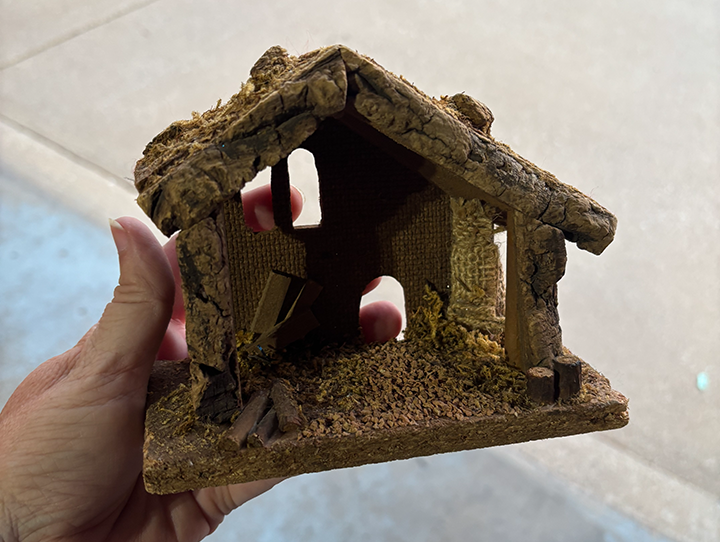
So after the pallet sold, I found the gentleman who bought it and asked if he'd be willing to sell me just that one little manger. He looked at it. Looked at me. And said: “I think you should have it.” And he gave it to me. Just gave it to me. After spending the day competing with people for piles of dirty stuff, that tiny act of kindness was one of my favorite parts of the entire auction.
More good junk.
The treasures kept coming. An Art Deco scarf dancer bookend—sadly, only one, but she is fabulous. A woven basket cradle. A wonderfully worn red wooden stool. More crocks. An old Buckeye Brand Evaporated Milk wooden crate. All good. All old. All dirty. All cleanable. This is apparently the optimistic mantra we're using now.
woven basket cradle Buckeye Evaporated Milk Crate
And then I saw the Mucha.
My final purchase of the day was a large framed French poster designed by Alphonse Mucha. I knew what it was immediately. I studied Mucha's work when I was in design school in the early 1980s and have loved it ever since. His unmistakable Art Nouveau style—the women, the florals, the decorative linework—is one of those things permanently filed away in my brain. So when I saw this piece, there was no “Hmmm, I wonder who designed that?” MUCHA.

Now, before anyone starts planning my retirement: I'm assuming this is a reproduction and not an original lithograph. I'll take it apart this week and investigate it more closely. But original or reproduction, I loved finding something at an auction that connected so immediately to something I studied more than 40 years ago. And with that, I was finished.
Six hours is enough dirt.
Technically, the auction wasn't over. Not even close. But I'd been there for almost six hours. I'd filled a substantial portion of my vehicle. I'd acquired bottles, baskets, bowls, pottery, enamelware, a spice cupboard, a book rack, a crate, a stool, a basket cradle, an Art Deco dancer, a Mucha poster and enough accumulated grime to start my own small agricultural operation.
Then I got outbid on a couple boxes of Christmas. Normally that might have irritated me. Instead, I looked around and thought: You know what? They can have it. That's how you know you're done. Things that looked fascinating at 10:00 a.m. start looking remarkably less necessary six hours later. So we called it. Was there still good stuff left? Absolutely. Did I need any more of it? ABSOLUTELY NOT.
Now comes the less glamorous portion of vintage treasure hunting: Unloading. Sorting. Researching.
And apparently... A LOT OF CLEANING.
Take the back road.
Find the good junk.
And sometimes, you gotta wash it.


Comments